At StackParking, we design, manufacture, install, and maintain advanced mechanical and automated parking systems for residential, commercial, institutional, and industrial projects across Mumbai and Maharashtra. Our solutions are engineered to optimize available space while delivering reliable performance, high safety standards, and long-term operational efficiency.
In this comprehensive guide, we explain everything you need to know about automated car parking system costs in Mumbai, including the different types of parking systems, the factors that influence pricing, installation requirements, maintenance considerations, and how to choose the right solution for your project.
Why Automated Parking Systems Are Becoming Essential in Mumbai
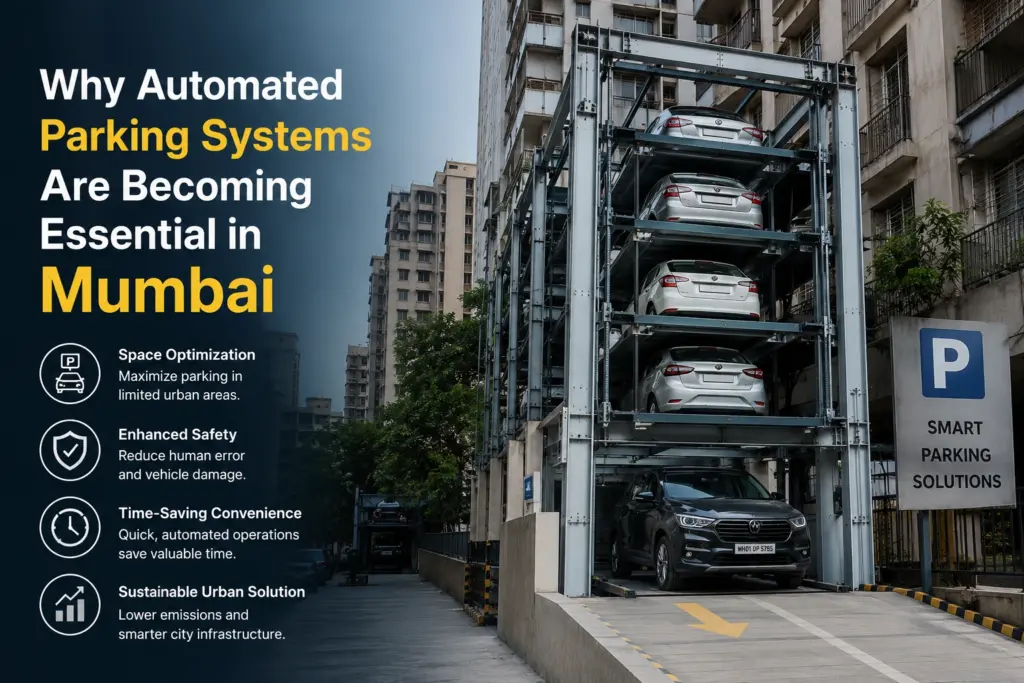
Mumbai faces a unique combination of rapid urban development, limited land availability, and continuously increasing vehicle ownership. Conventional parking layouts are no longer sufficient for modern buildings where maximizing space utilization is a priority.
Automated parking systems offer a practical solution by allowing developers and property owners to significantly increase parking capacity without expanding the building footprint. These systems are increasingly being adopted in:
- Residential Apartments
- Housing Societies
- Commercial Buildings
- Corporate Offices
- IT Parks
- Hospitals
- Hotels
- Shopping Malls
- Educational Institutions
- Government Buildings
- Industrial Facilities
- Mixed-Use Developments
Whether the objective is to provide additional parking for residents, improve customer convenience, or comply with parking regulations, automated parking technology offers a scalable and future-ready solution.
What Is an Automated Car Parking System
An automated car parking system is a mechanical or computerized solution that stores vehicles using engineered lifting and transfer mechanisms instead of conventional ramps and manually driven parking.
Unlike traditional parking areas where drivers search for vacant spaces, automated systems utilize hydraulic, electro-mechanical, or robotic technologies to position vehicles efficiently within a structured parking arrangement.
Depending on the project requirements, automated parking systems may use:
- Hydraulic lifting platforms
- Mechanical pallets
- Vertical elevators
- Horizontal shuttle systems
- PLC-controlled automation
- Smart sensors
- Integrated safety mechanisms
- Intelligent parking management software
These technologies work together to optimize parking capacity while minimizing the land required for vehicle storage.
Automated Car Parking System Cost in Mumbai
One of the first questions property developers, housing societies, architects, and business owners ask is, “How much does an automated car parking system cost in Mumbai?”
The answer depends on several engineering and project-specific factors. Unlike off-the-shelf products, mechanical parking systems are custom-designed according to the available space, vehicle dimensions, structural conditions, parking capacity requirements, and automation level.
For this reason, there is no single fixed price. Instead, the final investment is determined after a technical site survey and feasibility assessment.
Estimated Cost Range of Automated Parking Systems
| Parking System | Typical Investment | Suitable For |
|---|---|---|
| Stack Parking System | ₹1.20 Lakhs – ₹6 Lakhs per parking module | Apartments, Villas, Offices |
| Puzzle Parking System | ₹8 Lakhs – ₹30 Lakhs+ | Commercial Buildings, Residential Projects |
| Tower Parking System | ₹75 Lakhs – ₹5 Crores+ | High-Rise Buildings, Hotels, Malls |
| Rotary Parking System | ₹20 Lakhs – ₹70 Lakhs | Small Commercial Buildings |
| Fully Automated Parking | Project Based | Airports, Smart Cities |
The above figures are indicative only. Actual pricing depends on engineering design, capacity, site conditions, automation level, and project scope.
How Does an Automated Parking System Work
Although the exact operation depends on the type of parking system selected, the overall process is straightforward and user-friendly.
Step 1: Vehicle Positioning
The driver parks the vehicle on the designated platform or entry bay, following simple guidance markings or operator instructions.
Step 2: Safety Verification
Sensors verify that the vehicle is correctly positioned and that all safety conditions are met before the system begins operation.
Step 3: Automated Parking Movement
The parking system automatically lifts, shifts, or transfers the vehicle to its assigned parking location using hydraulic or mechanical components controlled by a programmable logic controller (PLC).
Step 4: Secure Vehicle Storage
The vehicle remains securely stored until retrieval is requested.
Step 5: Vehicle Retrieval
When required, the system automatically returns the vehicle to the delivery position, allowing the driver to exit without navigating ramps or tight parking aisles.
This streamlined process reduces parking time, minimizes driver effort, and improves overall parking efficiency.
Major Types of Automated Parking Systems in Mumbai
Choosing the right parking solution begins with understanding the available technologies. Each system offers distinct advantages depending on the building type, available space, parking demand, and investment budget.
1. Stack Parking System
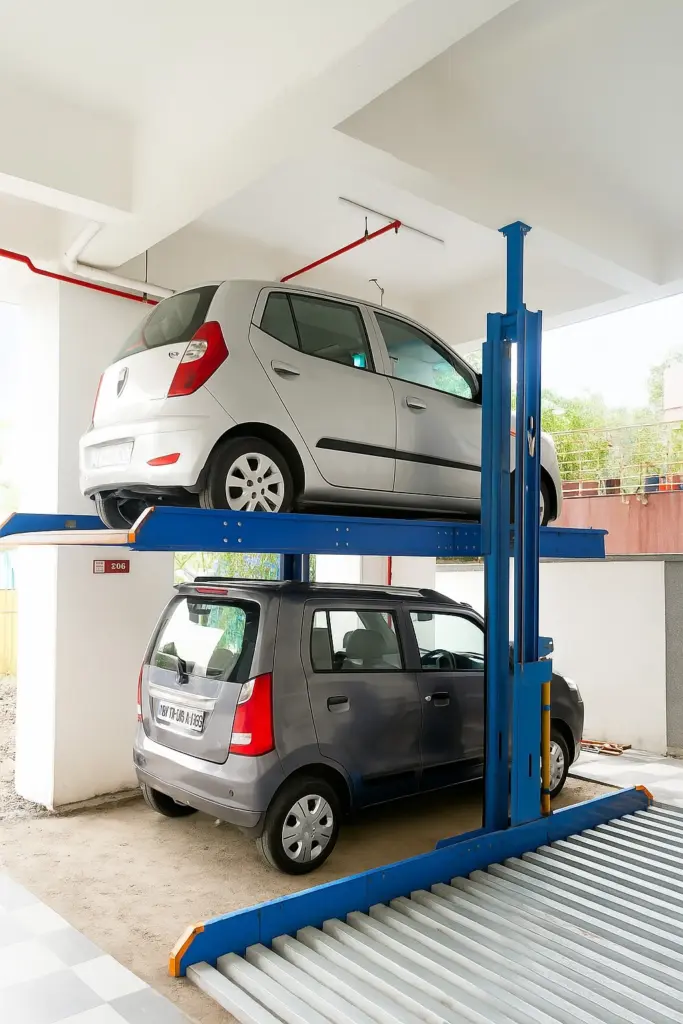
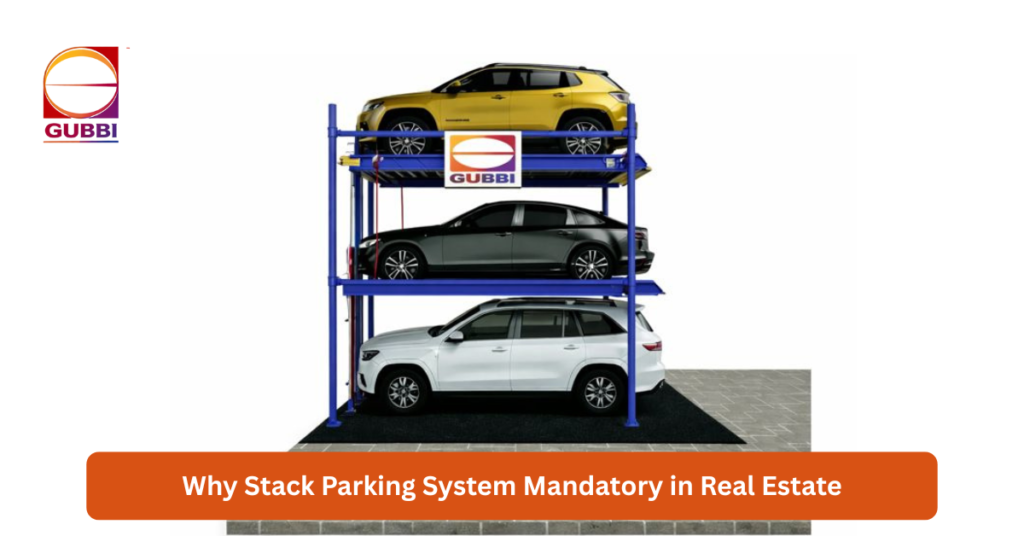
A Stack Parking System is one of the most practical and cost-effective mechanical parking solutions available today. It uses hydraulic lifting technology to park one vehicle above another, effectively doubling or tripling the available parking capacity without increasing the ground area.
Stack parking systems are particularly suitable for residential buildings, housing societies, villas, corporate offices, and small commercial developments where additional parking is required within a limited footprint.
Key Features
- Hydraulic lifting mechanism
- Compact design
- Easy operation
- Low maintenance requirements
- High structural reliability
- Fast installation
- Efficient use of vertical space
Ideal Applications
- Apartment complexes
- Residential societies
- Office buildings
- Hotels
- Hospitals
- Independent homes
- Commercial complexes
2. Puzzle Parking System
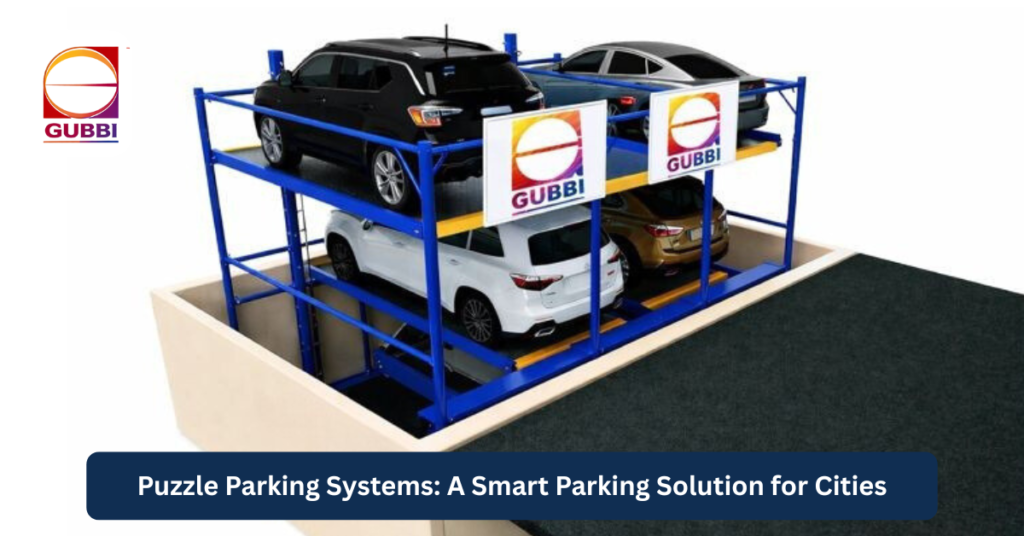
Puzzle Parking Systems utilize both vertical and horizontal movement to maximize parking density. Vehicles are stored on movable pallets that automatically shift to create space for parking and retrieval.
This system is highly efficient for projects where maximizing the number of parking spaces is essential without constructing additional basements.
Advantages
- High parking density
- Fully automated movement
- Flexible layout configurations
- Suitable for irregular plot sizes
- Minimal operator intervention
- Faster vehicle retrieval
- Future expansion capability
Suitable For
- Commercial Buildings
- Corporate Offices
- Hospitals
- Educational Institutions
- Premium Residential Projects
- Mixed-Use Developments
3. Tower Parking System
Tower Parking Systems are fully automated vertical parking solutions designed for locations where land availability is extremely limited.
Vehicles are transported vertically using automated lifts and intelligently stored within a steel tower structure.
These systems can accommodate dozens or even hundreds of vehicles while occupying a remarkably small ground footprint, making them ideal for premium urban developments.
Benefits
- Exceptional space optimization
- Maximum parking capacity
- Fully automated operation
- Premium user experience
- Enhanced vehicle security
- Reduced land requirement
- High operational efficiency
Best Applications
- Metro Cities
- Luxury Residential Towers
- Business Districts
- Shopping Centres
- Airports
- Smart City Projects
4. Rotary Parking System
Rotary parking systems rotate vehicles vertically in a continuous loop, similar to a Ferris wheel. They provide a compact parking solution for locations with limited land and moderate parking demand.
Ideal For
- Car Showrooms
- Hotels
- Clinics
- Small Commercial Buildings
- Urban Developments
5. Fully Automated Robotic Parking System
Robotic parking systems represent the latest advancement in parking technology. Vehicles are transported automatically by intelligent robotic mechanisms without requiring drivers to enter the parking structure.
These systems provide:
- Maximum automation
- High retrieval speed
- Minimal human intervention
- Premium parking experience
- Smart software integration
- Advanced security features
They are typically used in airports, luxury developments, large commercial complexes, and high-value urban infrastructure projects.
Why More Builders Choose StackParking
Selecting the right parking partner is as important as selecting the right parking system.
At StackParking, we focus on delivering engineered parking solutions that combine safety, reliability, and long-term value. Every project begins with a detailed site assessment to understand structural constraints, vehicle flow, and future expansion needs. Our team then recommends the most suitable parking technology rather than a one-size-fits-all solution.
Our services include:
- Site survey and feasibility analysis
- Custom parking system design
- Manufacturing with high-quality materials
- Professional installation
- Testing and commissioning
- Operator training
- Annual Maintenance Contracts (AMC)
- Spare parts support
- After-sales technical assistance
By combining engineering expertise with responsive service, StackParking helps developers, housing societies, and commercial property owners create efficient parking infrastructure that supports the long-term success of their projects.
What Determines the Cost of an Automated Parking System?
Many people compare prices without understanding that parking systems are engineered solutions rather than standard products. Two projects with the same number of parking spaces may have completely different costs due to site conditions and technical requirements.
Below are the key factors that influence pricing.
1. Available Space
The dimensions of your site directly affect the design of the parking system.
Our engineering team evaluates:
- Plot width
- Plot length
- Clear height
- Basement depth
- Ramp availability
- Turning radius
- Structural columns
- Entry and exit points
A well-planned layout can reduce unnecessary construction costs while maximizing parking capacity.
2. Number of Cars Required
The larger the parking requirement, the more sophisticated the engineering becomes.
Typical project capacities include:
- 10 Cars
- 20 Cars
- 40 Cars
- 60 Cars
- 100 Cars
- 200+ Cars
Higher-capacity systems often provide better value per parking space because fixed costs are distributed across more units.
3. Type of Building
Every building has unique operational requirements.
Examples include:
Residential Buildings
Focus on reliability, ease of use, and low maintenance.
Commercial Buildings
Require faster retrieval times and higher daily usage.
Hospitals
Need uninterrupted operation with quick vehicle access.
Hotels
Emphasize convenience and a premium guest experience.
Shopping Centres
Must handle high vehicle turnover efficiently.
4. Vehicle Dimensions
Parking systems are designed according to the types of vehicles they will accommodate.
Typical categories include:
- Hatchbacks
- Sedans
- SUVs
- Premium Luxury Cars
- Electric Vehicles
Larger vehicles require wider platforms, greater lifting capacities, and additional structural support.
5. Platform Load Capacity
Most parking systems are engineered for:
- 2,000 kg
- 2,300 kg
- 2,500 kg
- 3,000 kg
Projects serving luxury SUVs or commercial vehicles may require higher-capacity platforms, increasing equipment costs.
6. Civil Construction Requirements
In addition to the parking equipment, the project may require civil work such as:
- RCC foundations
- Pit excavation
- Waterproofing
- Drainage
- Floor leveling
- Utility relocation
- Concrete reinforcement
The extent of civil work varies significantly between sites.
7. Structural Steel Requirements
The amount of structural steel depends on:
- Building height
- Parking capacity
- Span lengths
- Seismic design
- Wind load requirements
- Local regulations
Using high-quality steel enhances durability and long-term performance.
8. Automation Features
Modern parking systems can be equipped with advanced technologies such as:
- RFID access
- Touchscreen controls
- PLC automation
- Mobile app integration
- License plate recognition
- IoT monitoring
- CCTV integration
- Remote diagnostics
These features improve user convenience and operational efficiency.
9. Safety Systems
Safety is one of the most important aspects of any automated parking system.
A professionally engineered system includes:
- Emergency stop buttons
- Hydraulic safety locks
- Anti-fall devices
- Limit switches
- Overload protection
- Motion sensors
- Photoelectric sensors
- Audible alarms
- Automatic fault detection
- Emergency manual operation
At StackParking, every installation is designed with multiple layers of safety to protect users, vehicles, and equipment.
Hidden Costs Buyers Often Overlook
Many buyers compare only the equipment price and overlook additional project expenses. Understanding the complete investment helps avoid unexpected costs.
Common considerations include:
- Civil work
- Electrical wiring
- Power supply upgrades
- Foundation preparation
- Structural modifications
- Drainage systems
- Waterproofing
- Fire safety integration
- Government approvals (where applicable)
- Annual maintenance contracts
- Operator training
Planning for these elements from the outset ensures smoother project execution.
Installation Process
A successful parking system installation follows a structured engineering workflow.
Step 1 – Site Survey
Engineers inspect the site, take measurements, and assess structural conditions.
Step 2 – Feasibility Study
A technical evaluation determines the most suitable parking solution based on available space, vehicle requirements, and budget.
Step 3 – System Design
Detailed engineering drawings are prepared, including equipment layout, structural design, electrical plans, and operational flow.
Step 4 – Manufacturing
Components are fabricated using high-quality steel and precision manufacturing processes.
Step 5 – Civil Preparation
Foundations, pits, and structural supports are prepared according to the approved design.
Step 6 – Installation
The parking equipment is assembled, aligned, and integrated with electrical and control systems.
Step 7 – Testing and Commissioning
The entire system undergoes rigorous testing to verify safety, functionality, and operational performance before handover.
How Long Does Installation Take
The project timeline depends on the type and scale of the system.
| Parking System | Estimated Installation Time |
|---|---|
| Stack Parking | 1–4 Weeks |
| Puzzle Parking | 4–8 Weeks |
| Rotary Parking | 3–6 Weeks |
| Tower Parking | 3–8 Months |
| Fully Automated Parking | 6–12 Months |
These timelines may vary depending on project complexity, site readiness, and local approvals.
Maintenance Costs
Like elevators and other mechanical equipment, automated parking systems require regular maintenance to ensure safe and reliable operation.
A preventive maintenance program typically includes:
- Hydraulic oil inspection
- Lubrication of moving parts
- Sensor calibration
- PLC diagnostics
- Electrical panel checks
- Structural inspection
- Bolt tightening
- Safety device testing
- Cleaning and adjustment of components
Routine servicing helps minimize downtime, extend equipment life, and maintain optimal performance.
Why Preventive Maintenance Matters
Regular maintenance offers several long-term benefits:
- Improved safety
- Reduced risk of unexpected breakdowns
- Longer equipment lifespan
- Lower repair costs
- Consistent operational performance
- Higher user satisfaction
At StackParking, Annual Maintenance Contracts (AMC) provide scheduled inspections, preventive servicing, and technical support to keep systems operating efficiently.
Return on Investment (ROI): Is an Automated Car Parking System Worth the Investment?
When evaluating an automated parking system, it is important to look beyond the initial purchase cost. The true value lies in how efficiently the system uses available space and how it contributes to the long-term success of a property.
In cities like Mumbai, where land values are among the highest in India, every square metre of space has significant financial value. Increasing parking capacity without purchasing additional land can improve the usability of a property while supporting future growth.
Long-Term Benefits
- Better utilization of available land
- Increased parking capacity within the same footprint
- Improved convenience for residents, visitors, and customers
- Enhanced property appeal for buyers and tenants
- Organized traffic flow inside the premises
- Reduced vehicle movement within parking areas
- Efficient management of high-density developments
- Long service life with proper maintenance
For developers, commercial property owners, and housing societies, these advantages often make automated parking systems a practical long-term infrastructure investment.
Stack Parking vs Puzzle Parking vs Tower Parking
| Feature | Stack Parking | Puzzle Parking | Tower Parking |
|---|---|---|---|
| Automation Level | Semi-Automatic | Automatic | Fully Automatic |
| Space Utilization | Good | Excellent | Maximum |
| Suitable For | Residential Buildings | Commercial & Residential Projects | High-Rise Developments |
| Initial Investment | Lower | Medium | Higher |
| Parking Capacity | Medium | High | Very High |
| Vehicle Retrieval | Fast | Fast | Automated |
| Expansion Possibility | Moderate | High | Project Specific |
| Maintenance | Low | Moderate | Planned Preventive Maintenance |
| Best Choice | Apartments & Societies | Mixed-Use Projects | Premium Urban Developments |
Benefits of Installing an Automated Parking System
Maximize Limited Space
Automated parking systems make efficient use of vertical and horizontal space, allowing more vehicles to be accommodated within the same area compared to conventional parking layouts.
Improve Property Value
Modern parking infrastructure can enhance the overall functionality and attractiveness of residential and commercial developments.
Better Vehicle Protection
Controlled parking environments reduce unnecessary vehicle movement and help minimize accidental damage during parking.
Faster Parking Experience
Well-designed systems reduce the time spent searching for parking spaces and improve overall traffic movement within the property.
Reduced Operational Complexity
Automation simplifies parking management and provides a more organized experience for users.
Future-Ready Infrastructure
As vehicle ownership continues to grow in metropolitan cities, mechanical parking solutions help properties adapt to increasing parking demand.
Common Mistakes to Avoid When Purchasing a Parking System
Choosing a parking system is a long-term investment. Avoiding common mistakes can help ensure better performance and reliability.
Selecting Based Only on Price
The lowest-priced solution may not always be the most suitable. Consider quality, engineering, safety, and long-term support.
Ignoring Site Conditions
Every project has unique structural and spatial requirements. A professional site assessment is essential before finalizing a solution.
Underestimating Future Parking Demand
Designing only for current needs may lead to capacity issues later. Planning for future growth can reduce expansion costs.
Overlooking Maintenance Planning
Regular preventive maintenance helps extend equipment life and maintain reliable operation.
Choosing an Inexperienced Supplier
Experience in design, manufacturing, installation, and after-sales service plays a significant role in the long-term success of a parking project.
How to Choose the Right Automated Parking System
Before selecting a parking solution, consider the following:
- Available land area
- Number of vehicles to be accommodated
- Type of vehicles (cars, SUVs, EVs)
- Nature of the building
- Daily parking frequency
- Structural limitations
- Budget
- Desired automation level
- Future expansion plans
- Service and maintenance support
A detailed engineering assessment helps identify the most suitable system for each project.
Typical Applications
Automated parking systems are widely used across different sectors.
Residential Apartments
Provide organized parking for residents while maximizing available space.
Housing Societies
Increase parking capacity without major structural expansion.
Commercial Buildings
Support employee and visitor parking in high-demand urban locations.
Hospitals
Improve accessibility by reducing parking congestion.
Hotels
Offer guests a smoother and more convenient arrival experience.
Shopping Centres
Handle higher vehicle volumes efficiently during peak hours.
Corporate Offices
Optimize parking for employees and visitors while improving site management.
Educational Institutions
Provide structured parking for staff, students, and visitors.
Why Choose StackParking
At StackParking, we believe that every parking project deserves a solution tailored to its unique requirements. Rather than offering standard products, we work closely with architects, builders, developers, consultants, and property owners to design systems that maximize efficiency, safety, and long-term value.
Our Expertise Includes
- Stack Parking Systems
- Puzzle Parking Systems
- Tower Parking Systems
- Mechanical Parking Solutions
- Parking System Design
- Site Evaluation
- Engineering Consultation
- Professional Installation
- Testing & Commissioning
- Annual Maintenance Contracts (AMC)
- Technical Support
What Sets StackParking Apart?
- Experienced engineering team
- Custom-designed parking solutions
- High-quality manufacturing
- Focus on safety and reliability
- Professional installation process
- Preventive maintenance support
- Responsive after-sales service
- Solutions for residential, commercial, and industrial projects
Our goal is to help customers make the best use of available space while delivering dependable parking infrastructure that performs efficiently for years to come.
Frequently Asked Questions (FAQs)
What is the average cost of an automated car parking system in Mumbai?
The cost depends on the type of system, parking capacity, site conditions, automation level, and project requirements. A technical site survey is the best way to determine an accurate estimate.
Which parking system is best for residential buildings?
Stack Parking Systems are commonly chosen for residential apartments and housing societies because they offer an effective balance between space optimization and investment.
Is Puzzle Parking suitable for commercial buildings?
Yes. Puzzle Parking Systems are well suited for commercial projects where higher parking density and efficient vehicle movement are required.
How much space can be saved with an automated parking system?
The amount of space saved varies by project, but automated parking systems generally accommodate more vehicles within the same footprint than conventional parking layouts.
Are automated parking systems safe?
Yes. Modern systems include multiple safety mechanisms such as emergency stop functions, overload protection, sensors, and locking devices designed to support safe operation.
How often should a parking system be serviced?
Routine preventive maintenance should be carried out according to the manufacturer’s recommended schedule to ensure reliable performance.
Can existing buildings install automated parking systems?
Many existing residential and commercial properties can be upgraded with mechanical parking solutions after a technical feasibility assessment.
How long does installation take?
Installation time depends on the selected system and project complexity. Smaller stack parking projects are generally completed faster than large tower parking installations.
Do automated parking systems require operators?
Many systems are designed for simple user operation, while larger or more complex installations may include trained operators depending on project requirements.
Does StackParking provide after-sales support?
Yes. StackParking offers installation support, preventive maintenance, technical assistance, and Annual Maintenance Contracts (AMC) to help ensure reliable long-term operation.
Final Thoughts
As Mumbai continues to grow vertically and available land becomes increasingly valuable, efficient parking infrastructure is no longer a luxury—it is an essential component of modern residential and commercial development.
An automated parking system enables property owners to make better use of limited space, improve user convenience, and create organized parking environments that support long-term operational efficiency. The ideal solution depends on your building type, parking demand, available area, and future expansion plans.
Whether you are planning a new residential tower, upgrading an existing housing society, developing a commercial complex, or designing a large mixed-use project, choosing the right parking technology is a strategic investment.
StackParking.in provides customized Stack Parking, Puzzle Parking, and Tower Parking solutions backed by engineering expertise, professional installation, and dependable after sales support. Our team works closely with every client to recommend the most suitable system based on technical requirements and project goals, helping create smarter, safer, and more efficient parking solutions for the future.
Read Also – Types of Parking System